
Hīhīmanu
Spotted eagle ray
Aetobatus ocellatus
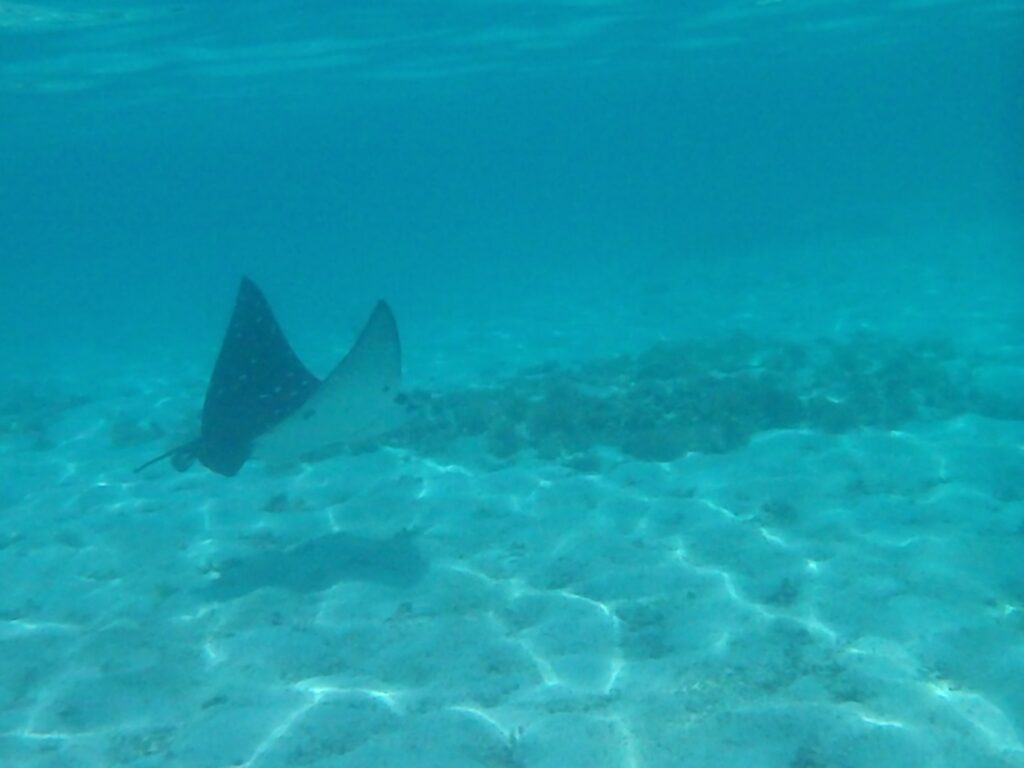
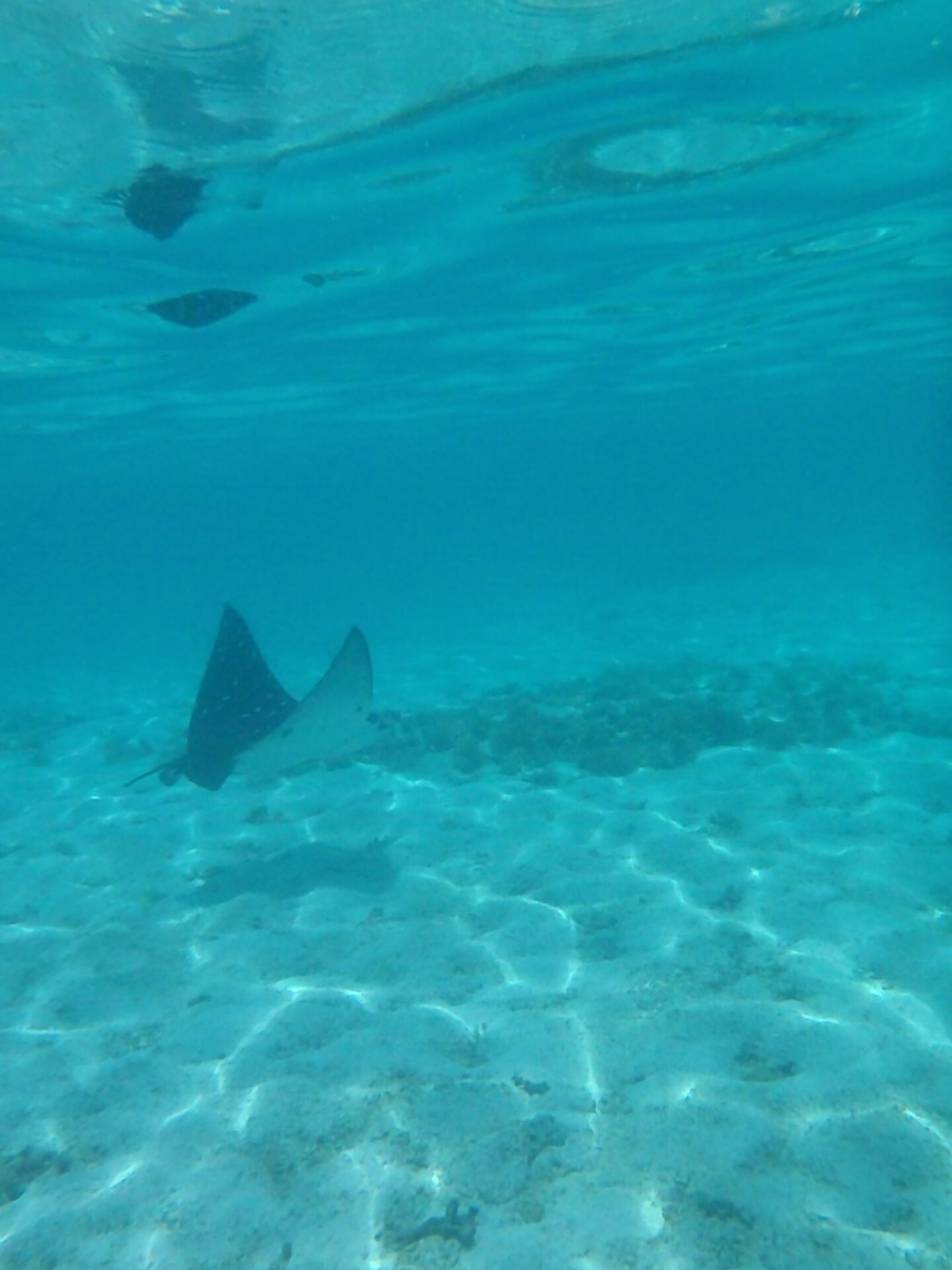
White-spotted rays that glide past the pier in the evening, often in small groups, and cruise over the sand flats of the lagoon.
| IUCN Red List | Endangered (2024) |
|---|---|
| Fishing | Not allowed in the State Marine Refuge |
| Seen most often | Near the pier and over sand in the lagoon |
Species Information
Hīhīmanu, also called hailepo, is the Hawaiian name for the spotted eagle ray. Its dark back is covered in small white spots, its belly is white and its long, whip-like tail carries one or more venomous barbs near the base. A pointed, duck-bill snout gives eagle rays their name. Hīhīmanu commonly reach 6 feet from wingtip to wingtip, and the largest are more than 9 feet across.
Rays in Hawaiʻi and the rest of the Indo-Pacific were once grouped with the Atlantic spotted eagle ray (Aetobatus narinari). In 2010 scientists recognized the Indo-Pacific rays as a separate species, Aetobatus ocellatus, sometimes called the ocellated or whitespotted eagle ray.
Feeding and Young
Hīhīmanu feed mostly over sand, where they dig for snails, clams, crabs, shrimp and sea urchins. Flat, plate-like teeth crush the shells, which the ray spits out before swallowing the soft meat.
Females give birth to live young after a pregnancy of more than a year, usually to four pups or fewer. In the main Hawaiian Islands, pups are born from October to December in sheltered bays.
Conservation Actions
The IUCN lists the spotted eagle ray as Endangered because its populations have declined across much of its range. Around Hōlanikū, fishing of any kind is not allowed in the Northwestern Hawaiian Islands State Marine Refuge, and the wider waters are protected as Papahānaumokuākea Marine National Monument and National Marine Sanctuary. Removing derelict nets from the reef and lagoon also protects rays.
Current Threats
Across their range, eagle rays are caught in fisheries and as bycatch in nets and longlines, and they have few young, so populations recover slowly. In the Northwestern Hawaiian Islands, derelict fishing nets that drift onto the reef can entangle rays. Sharks, mainly niuhi (tiger sharks), are their main natural predators in Hawaiʻi.
On Hōlanikū
KAC/DLNR crews see hīhīmanu from the pier and shoreline, especially in the evening, when they glide past alone or in small groups. Sightings show up in field blogs through the year. In 2025 crews reported them in March, in August alongside Galapagos sharks, and in December swimming around the pier at dusk. Sometimes only the tips of their wings break the surface. Snorkelers also see them gliding over the sand flats of the lagoon. Hāhālua (manta rays) are seen around Hōlanikū only occasionally.
Learn more
Hawaiʻi's Fishes on the spotted eagle ray, including size, feeding and when pups are born in Hawaiʻi.
Reef and lagoon fish
The fish, sharks and other ocean life that share the reef and lagoon of Hōlanikū.
Respecting wildlife
Protected on Hōlanikū
All wildlife on Hōlanikū is protected. The island is the Kure Atoll State Wildlife Sanctuary, inside Papahānaumokuākea Marine National Monument and National Marine Sanctuary, and entry is allowed only by permit. KAC/DLNR work on Hōlanikū is done under the Papahānaumokuākea co-managers' permits, along with other permits where needed, such as NOAA Fisheries permits for monk seal and sea turtle work and federal bird banding permits.
About our photos
Photos and video on this site were taken by permitted crews and partners during research and management work, usually from a distance with zoom or telephoto lenses so animals are not disturbed. Close-ups of animals being handled show permitted work such as banding, tagging, rescue or disentanglement.
Seeing marine animals elsewhere in Hawaiʻi
- Keep your distance: at least 10 feet from honu, 50 feet from monk seals (150 feet from a mother and pup), 50 yards from spinner dolphins and 100 yards from humpback whales. The dolphin and whale distances are federal law.
- Never touch, chase, feed or swim with them, and keep visits short.
- Use binoculars or your camera's zoom for a closer look, and don't fly drones near wildlife.
- Keep dogs on a leash on beaches.
- Report injured, entangled or stranded animals to the NOAA Marine Wildlife Hotline at 888-256-9840.
More marine life of Hōlanikū
Help protect native habitat on Hōlanikū
KAC/DLNR field crews monitor wildlife and restore habitat year-round. Your support keeps them on the island.