
Our work
Pollution Reduction
Clearing marine debris from the reefs and beaches of Hōlanikū (Kure Atoll), and cleaning up what the former U.S. Coast Guard station left behind.
← Back to Our WorkOverview
Remote, but not untouched
Hōlanikū has no permanent residents, yet it still faces pollution from two directions. Ocean currents carry fishing nets, rope and plastic from across the North Pacific onto its reefs and beaches every year. On land, the former U.S. Coast Guard LORAN Station Kure left behind contaminated soil and buried materials that still need to be managed.
Kure Atoll Conservancy and DLNR/DOFAW crews remove debris year-round, working with the Papahānaumokuākea Marine Debris Project, the Papahānaumokuākea Marine National Monument co-managing agencies and the U.S. Coast Guard.
Pollution reduction focuses on
- Removing nets and other entanglement hazards before they trap wildlife
- Securing debris on island until it can be shipped out
- Preventing invasive species from spreading on debris
- Monitoring and managing contamination from past military use
Year-round
Marine Debris Removal
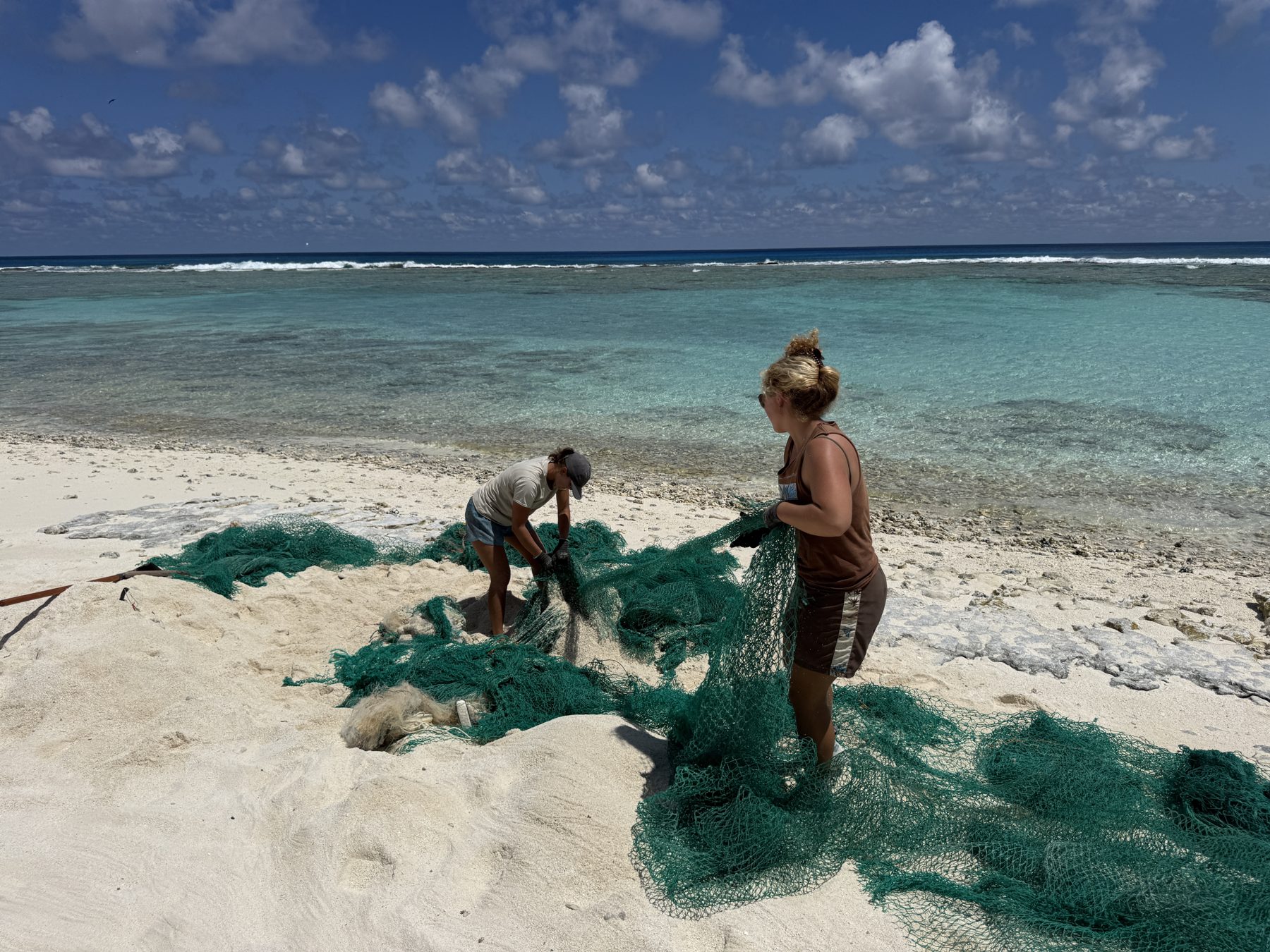
Derelict fishing nets are the biggest threat. They snag on the reef, smother coral and wash ashore in tangled masses that can trap ʻīlioholoikauaua (Hawaiian monk seals), honu (green sea turtles) and seabirds. Mōlī (Laysan Albatrosses) and kaʻupu (Black-footed Albatrosses) also mistake floating plastic for food and feed it to their chicks.
Because crews live on Hōlanikū year-round, they can act quickly. They check the shoreline during regular wildlife surveys and after every storm or tsunami, cut free nets and lines, and remove entanglement hazards from the shallow reef when needed. Hazardous materials that wash ashore are documented and secured, and the U.S. Coast Guard is notified.
Collect and secure
Nets, line, eel cones and other hazards are gathered into large bags and stored above the vegetation line at collection points around the island, so they cannot wash back out to sea or trap wildlife.
Record and share
Crews track the amount and type of debris they remove and share the data with Monument partners and NOAA, helping to identify sources and trends.
Teach with what washes up
Albatross boluses (pellets of undigested food that chicks cough up) often contain plastic. Crews collect them for education programs that show how ocean plastic reaches even the most remote islands.
Partnership
Large-Scale Cleanups with PMDP
The Papahānaumokuākea Marine Debris Project (PMDP) is a Honolulu-based nonprofit formed in 2019 to continue NOAA's long-running effort to clear derelict fishing gear from the Northwestern Hawaiian Islands. After joint missions with NOAA in 2020 and 2021, PMDP now leads large-scale debris removal across Papahānaumokuākea. Its teams of freedivers cut nets from the reef, while shore teams clear the beaches.
Throughout each season, KAC/DLNR crews collect entanglement hazards from the beaches and secure them on island. When the PMDP vessel arrives, PMDP and KAC/DLNR crews work together to remove everything the island crews have gathered, along with any new debris on the shoreline, while PMDP divers clear nets from the reef. The debris is then shipped to Honolulu.
Sources: KAC season reports; Hawaiʻi Board of Land and Natural Resources (PMDP permit, 2026).
One of the largest nets on record
In September 2023, PMDP and KAC/DLNR crews found an enormous net bundle on the shore beside the pier. Made mostly of thick rope with hundreds of loops that could trap animals, it weighed about 13,000 pounds and took 11 boatloads to get it out to the ship. PMDP described it as one of the largest single bundles of derelict gear in the history of the program.
Background
- 1996
NOAA began a multi-agency effort to remove derelict fishing gear from the Northwestern Hawaiian Islands. By 2005 it had removed about 492 metric tons.
- 2006
The Marine Debris Research, Prevention, and Reduction Act created the NOAA Marine Debris Program and an interagency coordinating committee.
- 2019
PMDP was formed to carry on large-scale removal in Papahānaumokuākea.
- 2021
Private donations raised by PMDP and KAC helped fund a spring mission that removed more than 28,000 pounds from Hōlanikū.
Biosecurity
Stopping Invasive Hitchhikers
Marine debris can carry more than plastic. Nets and other floating objects collect algae, invertebrates and other organisms as they drift, and moving that debris between islands could spread invasive species. One concern is Chondria tumulosa, a nuisance red alga that can smother coral reefs. It was first identified at Manawai (Pearl and Hermes Atoll) in 2016, spread to Kuaihelani (Midway Atoll), and was found at Hōlanikū in 2023.
Every debris operation follows the Monument's best management practices (BMPs). In 2023 the co-managing agencies adopted a BMP for nuisance algae that sets strict cleaning, inspection and disinfection steps for vessels, gear and marine debris moving into or out of affected areas.
On Hōlanikū
- Debris is bagged, often double-bagged, and stored in secure collection points away from the water.
- Bags and staging sites are mapped so debris can be loaded quickly and safely when a vessel arrives.
- Before debris leaves the island, crews follow Monument BMPs for invasive species, which may include fumigation, so insects and other pests do not travel with it.
At sea and in Honolulu
- Nets pulled from areas with nuisance algae are packed into sealed biosecurity bins, which limits how much can be taken from each site.
- Boats, dive gear and removal tools are cleaned and disinfected between islands.
- DLNR is consulted before any debris returns to the main Hawaiian Islands, where Chondria tumulosa has not been found.
Partners are still researching how long debris must be held, dried or treated to kill nuisance algae. These safeguards sometimes change cleanup plans: after Chondria tumulosa was found at Hōlanikū in 2023, PMDP moved its visit from July to September and limited reef removal so its biosecurity bins would not fill before reaching other islands. Learn more about how crews keep pests off the island on the Biosecurity page →
↑ Back to topicsLegacy cleanup
USCG Soil Remediation
The U.S. Coast Guard operated LORAN Station Kure on Green Island from 1961 to 1992. Polychlorinated biphenyls (PCBs) were used to cool electrical equipment such as transformers and were later buried in the station's dump sites. PCBs were banned in the 1970s after they were found to cause cancer and disrupt hormones.
Why it matters
PCBs build up in fatty tissue and become more concentrated in animals higher up the food chain. If they reached the lagoon, top predators that feed locally, such as monk seals, ulua (jacks) and puhi (eels), could accumulate harmful levels.
Long-term monitoring
Since the station closed in 1992, the Coast Guard has tested soil, groundwater, nearshore sediment and wildlife every five years under its closure agreement. Cleanup efforts in 1991–1994, 2008–2009 and 2011 did not bring PCB levels in the old dump site down far enough.
The 2016 project
From August 19 to September 3, 2016, the U.S. Coast Guard and its contractor, Element Environmental, LLC, excavated about 400 cubic yards of PCB-contaminated soil from the Scrap Metal Dump near the shoreline. The soil was reburied about 2,500 feet inland in a new pit beside the old runway, lined and wrapped with activated carbon, capped with a permeable liner and treated with microbes to help break down the PCBs.
The work disturbed important seabird nesting and monk seal pupping habitat. DLNR wildlife monitors guided the crews around nests and resting seals, and once the work was done, field crews replanted the disturbed areas with native plants to prevent erosion and invasive weeds.
A black rat found at the field camp later that month was likely carried ashore with the project's equipment. It was quickly caught, a reminder of why biosecurity matters for every project.
Other legacy hazards
Crews still find hazards left from the station years. In 2025 they found a pit of sticky, tar-like substance left from the station years that had trapped several mōlī chicks. The crew capped the pit with sand and reinforced it through the summer, and no more affected birds were seen.
Get involved
Help Keep Hōlanikū Clean
Every net removed is one less threat to the wildlife of Hōlanikū. Your support keeps crews on the island year-round.