Habitat Restoration Program

General Information

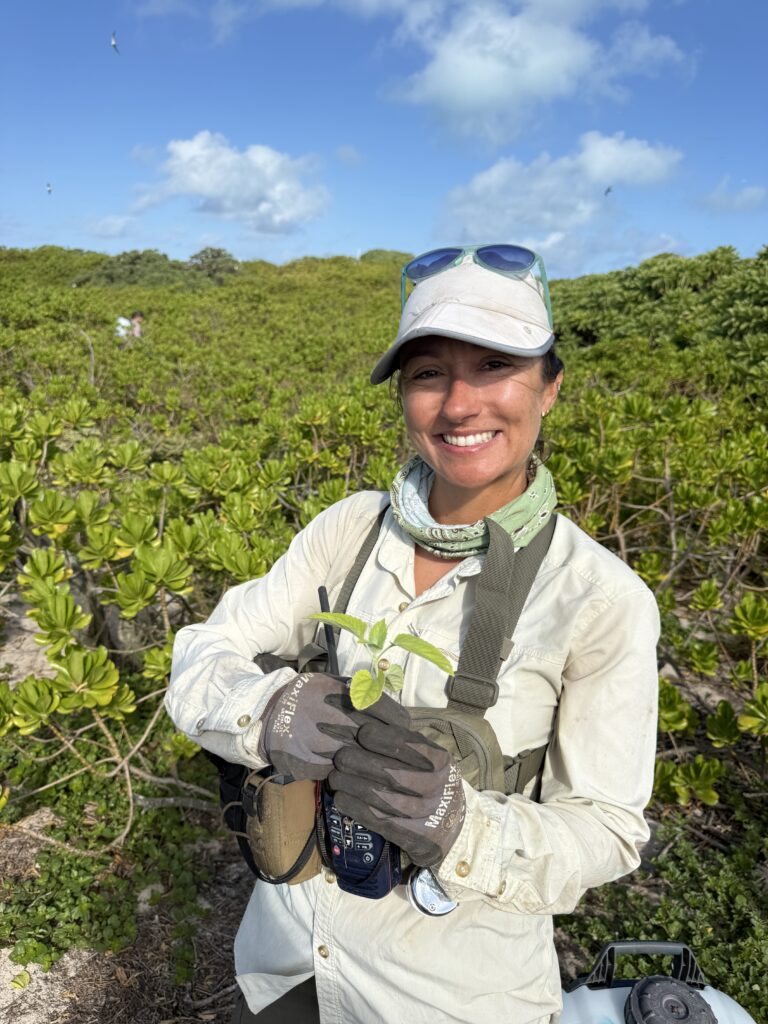
Habitat restoration is one of the largest focuses for field camps. These includes projects such as the eradication of invasive plants, restoration of native plants, as well as pest management. And over the years, management objectives have aimed to constantly modify field efforts in response to maintaining a balance between restoring an ecosystem and the impact the ecosystem receives from sudden changes.

Native Plant Restoration Project

Invasive Tree & Plant Eradication Project

The eradication program aims for a long-term resilient and diverse ecosystem. 5 out of the 45 plants on Kure are considered invasive; either because they have invaded large areas or appear to be adversely affecting the ecosystem.

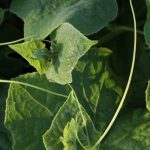
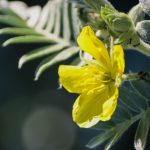
The most damaging are V. encelioides and Cenchrus echinatus, both of which have caused drastic habitat changes on the island by forming monospecific stands and shading out or otherwise replacing native vegetation communities.

The ultimate target is complete eradication of Verbesina encelioides from Kure Atoll.

The strategy comprises of 5 levels of action:
(1) prevention
(2) risk assessment and prioritization
(3) chemical and physical eradication
(4) restoration
(5) monitoring to evaluate success and aid in adaptive management

While our primary target is V. encelioides, concurrent eradication of all targeted species occurs in each area. So if there is an area where other invasive weeds are present, they are eradicated as well. This minimizes the potential of weeds taking over and decreases the time spent monitoring, thus, reducing the disturbance on birds.

Other invasive plants species targeted for eradication are:

  • Sandbur (Cenchrus echinatus)
  • Beach wire grass (Dactyloctenium aegyptium)
  • Alena haole (Boerhavia coccinea)
  • Ironwood Trees (Casuarina equisetifolia)
  • Bristly foxtail (Setaria verticillata)
  • Flaveria trinervia
  • Amaranthus spinosa
  • Kauna’oa pehu (Cassytha filiformis)

The spread of V. encelioides is implicated in the extinction of several endemic plant species and the range restriction of many others. In turn, nesting seabirds and invertebrates that depend on native vegetation for breeding habitat are negatively affected. V. encelioides may also be sustaining large populations of introduced ants and scale insects and has recently begun to encroach on dune habitat, compromising stability.

Finally, invasive weeds on Kure pose a threat to less invaded islands in the Northwest chain. Despite quarantine procedures, propagules from Kure can be introduced to less invaded islands via seabirds, migrants, or researchers, and as evidenced on Pearl and Hermes Reef, may rapidly become naturalized on an island.

Habitat Restoration on the Abandoned USCG Runway Project

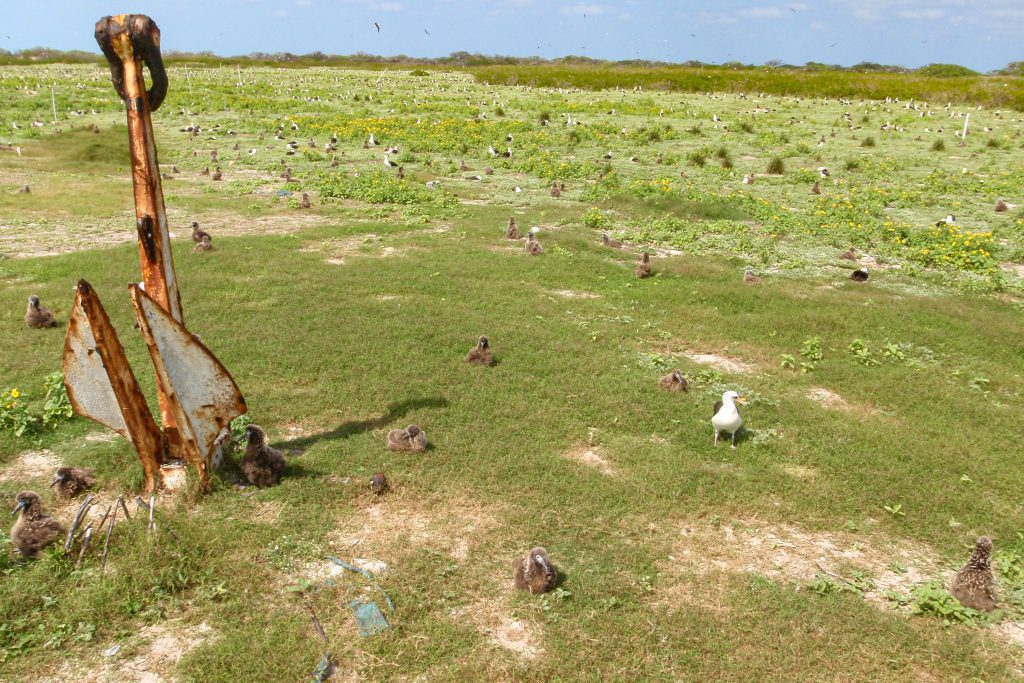
Today, the Southwest end of the runway is called The Landfill. The Landfill is a main focal point for habitat restoration as a way to rebuild the dunes and encourage black-footed and Laysan albatross to move their nest sites away from the vulnerable beachfront onto the adjacent elevated runway where there is increased protection from storm surge and tsunamis

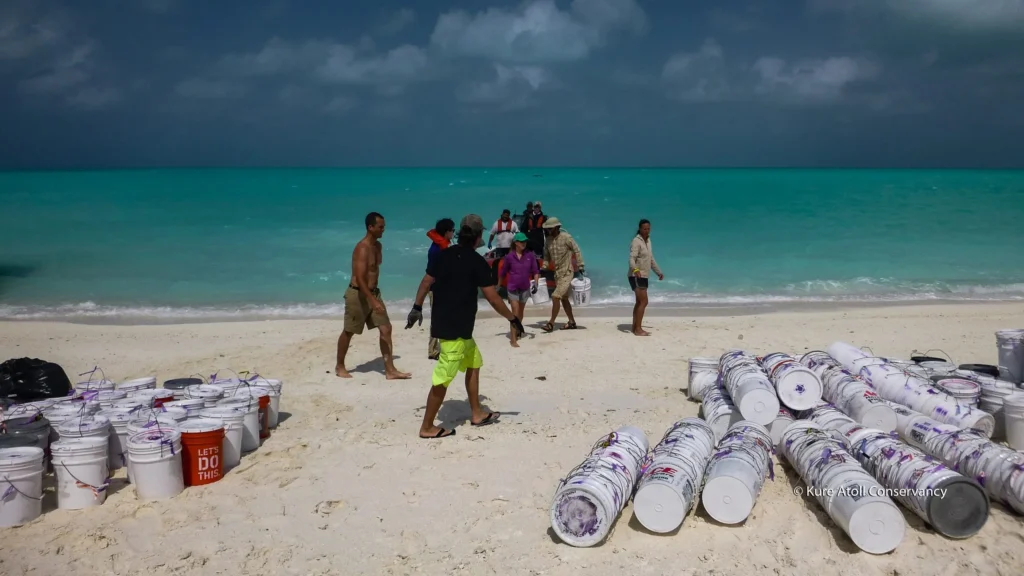
In 2016 an intensive restoration project began to break up the coral runway, adding fresh sand and planting native plants to create high-quality nesting habitat.

The United States Coast Guard LORAN-C Station Kure was constructed in 1960 and used as a radio navigation station from 1961-1993. During that construction time (1960), the dunes on the Southern-half of Green Island were removed to build a 4000’ runway. The USCG used the beachfront on the Southwestern end of the runway as a Scrap Metal Dump site where they buried electrical components containing hazardous materials. It is assumed they were dumped between the 1960s and the late 1970s when the USCG program established a hazardous waste management program. The site was cleaned up in 2016 during the Soil Remediation Project.

Dune Restoration and Creation Project

The main long-term conservation outcomes are to:

    • Expand the resilient native plant community
    • Increase breeding seabird population
    • Increase shorebird foraging habitat
    • Increase population and foraging habitat of Laysan Ducks
    • Increase native plant and invertebrate biological diversity

The 20-foot dunes that rim Green Island on the west side are higher and more extensive than any other Northwestern Hawaiian Island dunes.

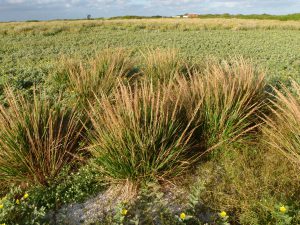
The integrity and function of Kure’s important dune-shrub complex are threatened by invasive plants. The main priority for dune creation and stabilization focus directly on sand retention with native grasses and plants.

The dunes are also considered critical habitat for the Hawaiian monk seal because they rest and pup in the dunes where they are protected from storms and sun.  Weed eradication and expanding the resilient native plant community supports wildlife and reduces storm/climate change damage.

Laysan Duck Translocation & Habitat Creation

1
Years of Preparation
1
Guzzlers Installed
1
Seeps Created
1
Ducks Translocated

In 2014, after years of habitat restoration work and coordinating with multiple agencies, 28 wild first year Laysan Ducks were chosen to be apart of the first translocation from Midway to Kure for an additional ‘insurance’ population to reduce extinction risks to the species.

From 2005-2014, each season’s fieldwork would contribute to a succession of objectives focused on creating a habitable environment for this critically endangered population.

Once widely distributed across the Hawaiian archipelago, and now 400-500 individuals, the Laysan duck is endangered and has had multiple translocation attempts. When future catastrophes strike, such as sudden flooding from sea level rise, tsunamis, and hurricanes, disease outbreaks, or accidental predator introductions, these disasters are unlikely to hit each island population simultaneously, or with the same magnitude, thus each island population serves as insurance for the species. Species extinction risks are dramatically reduced by restoring additional island populations and ultimately, Laysan ducks could be reintroduced to less vulnerable higher elevation islands in the future (USFWS 2009).

Because locations on higher islands (the main Hawaiian islands) are not yet free from predators or hybridization threats, recovery efforts focus on increasing the number of populations in the NWHI has remained a priority.

Black rat (Rattus rattus)
On August 20, 2016 an individual black rat (Rattus rattus) was documented for the first time in approximately 20 years by Karen Ladd from the USCG remediation team addressing contaminats left by the USCG LORAN station. Traps were quickly deployed and a rat was caught and dispatched on 31 August. The rat was documented during the timeframe of the PCB remediation project and is thought to have been transferred to shore with heavy equipment or cargo related to the project. Rat traps and attractants were immediately prepared and transferred to Kure from Midway aboard the M/V Kahana in response. To ensure other rats were not present DLNR personnel deployed the traps and began monitoring. Since then monitoring has been in place but no further rats have been confirmed.

In 2020, Kure Atoll supported approximately 60 adult birds or 20-30 potentially breeding pairs 6 years after the successful translocation from Midway Atoll. Reintroduction specialists recommend larger founding populations and long-term strategies for adding immigrants or supplemental birds to support the genetic diversity of these small isolated populations (Jaimeson 2010). However, the translocation plan for Kure called for two translocations for up to 50 founding birds and periodic immigrants yet only one translocation with 28 founding birds occurred.

A supplemental translocation is being planned for 2021 consisting of 10-25 added pre-breeder, wild Laysan ducks to Kure Atoll. Kure Atoll’s population of the endangered ducks reduces the species extinction risk and can be a source population for future translocations as well.

Pest Management

Project Overview

Big-headed ants (Pheidole megacephala) were widespread on Green Island and regularly observed attacking adult seabirds and chicks. An eradication program began on July 2, 2014. Two full-island treatments of Amdro were conducted at this rate with the use of blowers, hand-cranks and a walk behind applicator.

Shortly after the big-headed ant control began large numbers of arthropod species, especially beetles were noticed. This resurgence may demonstrate the severity of the Big-headed ants’ impact on the ecosystem.

Monitoring for BHA continues twice per year (once per field season)

Big-headed Ants (Pheidole megacephala)

Invasive ants are a significant conservation concern and can have far-reaching effects in ecosystems they invade. Limited unpublished observations of this particular ant species attacking nesting seabirds exist, but the frequency of attacks or how they affect seabird growth and survival are unknown.

Project Overview

Weekly mosquito surveys are conducted at all open water sources. Pool skimmer nets are dipped 10 times along the periphery of each water source and observations were recorded. Data collection includes the area of water source (sq. ft.), mosquito life-stages and quantity detected, treatment type and quantity applied. Water sources are treated to prevent the establishment of mosquitoes.

Southern house mosquito (Culex quinquefasciatus)
Culex quinquefasciatus, the Southern house mosquito, were documented on Kure starting August 22, 2016, and are thought to have blown over from nearby Midway Atoll. Mosquitos are carriers of Avian Pox.

Black rat (Rattus rattus)
On August 20, 2016 an individual black rat (Rattus rattus) was documented for the first time in approximately 20 years by Karen Ladd from the USCG remediation team addressing contaminats left by the USCG LORAN station. Traps were quickly deployed and a rat was caught and dispatched on 31 August. The rat was documented during the timeframe of the PCB remediation project and is thought to have been transferred to shore with heavy equipment or cargo related to the project. Rat traps and attractants were immediately prepared and transferred to Kure from Midway aboard the M/V Kahana in response. To ensure other rats were not present DLNR personnel deployed the traps and began monitoring. Since then monitoring has been in place but no further rats have been confirmed.

Cattle Egrets (Bubulcus ibis)
Periodically, cattle egrets (Bubulcus ibis) have been documented on Kure most likely originating from nearby Midway Atoll where the species is established and reproducing. Cattle egrets are considered a pest because they prey on the chicks of seabirds and Laysan ducklings. As long as cattle egrets are present on Midway, Kure staff will be prepared to prevent the species from establishing on Kure. The Department of Interior USFWS authorizes the removal of cattle egrets under Migratory Bird Permits: Control order for Introduced Migratory Bird Species in Hawaii. 50 CFR part 21.

×