Mōlī
Laysan Albatross
Phoebastria immutabilis
A large, graceful albatross that nests by the tens of thousands across Hōlanikū each winter.
| State recognized | Indigenous |
|---|---|
| NatureServe Global Rank | G3 Vulnerable |
| IUCN Red List | Near Threatened |
| USFWS Bird of Conservation Concern | Yes (2021) |

Species Information
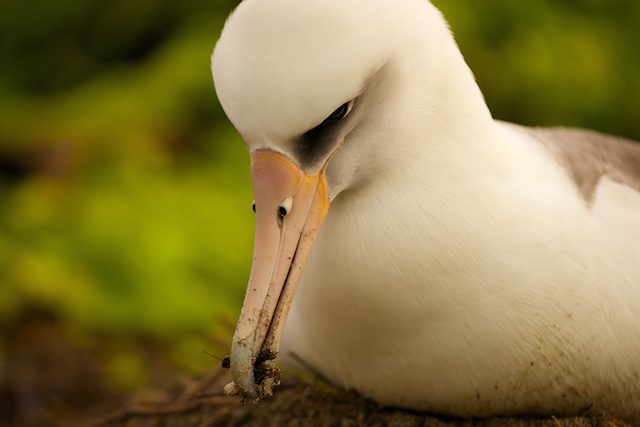
The mōlī, or Laysan Albatross, is a large, abundant seabird (family Diomedeidae) whose nesting range is centered in Hawaiʻi. Adults are mostly white with dark upperwings, back and tail. The underwings are white with varying amounts of black, especially along the edges. The bill is pink with a gray hooked tip, and the legs and feet are pale pink.
Like all albatrosses, mōlī are expert fliers that use dynamic soaring to travel great distances with little effort. They feed mainly at night, often far from the colony; one trip can cover 1,770 kilometers (1,100 miles). Mōlī seize prey from the surface while sitting on the water, often feeding with other mōlī but rarely with other species. They scavenge and follow fishing boats, though less often than kaʻupu (Black-footed Albatross). In Hawaiʻi their diet is mostly squid, along with deep-water crustaceans, fish and flying fish eggs.
Foraging & Nesting
Mōlī nest mainly on low coral and sand islands, where they use flat, open areas, but they also nest on steep, rocky slopes of high islands such as Nihoa and Lehua. Away from the colony they spend nearly all their time over the open ocean.
Like most seabirds, mōlī nest in colonies, keep the same mate for many years, return to the same nest area and lay only one egg a season. Both parents share every part of raising the chick. Pairs perform long, noisy courtship dances. Mōlī usually nest closer to vegetation than kaʻupu do, in a nest that ranges from a simple scrape to a ring of sand, plants and debris.
In Hawaiʻi, eggs are laid in November and December and chicks fledge in July, with no parental care after fledging. Young birds stay at sea until their third year. When they return they do not nest at first; instead they dance, build practice nests and look for a mate. Most mōlī first breed at eight or nine years old. The oldest known wild bird, a mōlī named Wisdom on Kuaihelani (Midway Atoll), hatched a chick in January 2025 at an age of at least 74.
Distribution & Abundance
Mōlī nest throughout the Northwestern Hawaiian Islands, on Kauaʻi and Oʻahu, and on Lehua off Niʻihau. Smaller colonies are found on islands off Japan and Mexico. Outside the nesting season they spread widely across the North Pacific.
Most of the world's mōlī nest within the Hawaiian Islands National Wildlife Refuge and on Kuaihelani (Midway Atoll). Kuaihelani alone had 589,623 nests in the 2025–26 season, the fourth-highest count on record. Kamole (Laysan Island) holds the next largest colony. On the main Hawaiian Islands, the largest colonies are at Kīlauea Point National Wildlife Refuge on Kauaʻi and Kaʻena Point Natural Area Reserve on Oʻahu, where predators are controlled.
Conservation Actions
Mōlī are protected under the federal Migratory Bird Treaty Act and State of Hawaiʻi law, and the U.S. Fish and Wildlife Service lists them as a Bird of Conservation Concern. Hawaiʻi's State Wildlife Action Plan calls for continued predator control at main-island colonies, control of invasive plants in nesting areas (including on Hōlanikū), lead clean-up on Kuaihelani, protection of refuges, reducing bycatch in fisheries, education about plastic pollution and starting new colonies on higher islands safe from sea level rise.
On Hōlanikū, removing golden crownbeard (Verbesina encelioides) and other invasive plants keeps open nesting space for mōlī, and Polynesian rats were removed from the island in the 1990s.
Current Threats
Today the biggest threats are at sea and from a changing climate. Mōlī are caught as bycatch on longline fishing hooks, and adults often feed their chicks floating plastic mistaken for food. Most mōlī nest on low islands only a few feet above sea level, where rising seas and stronger storms can wash over nests. On Kuaihelani, chicks that eat lead paint chips from old buildings suffer lead poisoning, and introduced predators threaten colonies on the main islands. Crews on Hōlanikū also watch for highly pathogenic avian influenza, which has not been found there.
In the past, people killed huge numbers of albatrosses. Feather hunters wiped out colonies on Johnston, Wake and Marcus islands around 1900 and killed some 300,000 birds on Kamole in 1909. Many more died during World War II, and between 1954 and 1964 about 54,000 albatrosses were killed on Kuaihelani to reduce collisions with aircraft. High-seas drift nets killed thousands each year until they were banned in 1993.
On Hōlanikū
Mōlī are the most numerous albatross on Hōlanikū, nesting mainly in the island's vegetated interior. KAC/DLNR crews count every nest each December and every chick before fledging in May or June. The December 2024 count found 37,914 nests, and 21,048 chicks were counted the following spring.


Kumulipo: Hawaiian Creation Chant
Hanau ka Moho, he makua
Born was the Rail, the parent
Puka kana keiki he Moli, lele
Out came its child a brown Albatross, and flew
-Line 311-312
The Kiamanu Project
Mōlī are honored in traditional Hawaiian practices and ceremonies. Much of that knowledge is being reawakened through the community, the Office of Hawaiian Affairs and the Kiamanu Project.
mō.lī
n. 1. Laysan albatross (Phoebastria immutabilis). (KL. line 312.)
2. Any straight line separating designs in tattoo pattern.
3. Bone made into a tattooing needle, hence a tattooing needle.
More seabirds of Hōlanikū
-
 ʻĀ
Masked Booby
-
 ʻĀ
Red-footed Booby
-
 ʻĀ
Brown Booby
-
 ʻAkihikēʻehiʻale
Tristram's Storm-Petrel
-
 ʻAoʻū
Christmas Shearwater
-
 ʻEwaʻewa
Sooty Tern
-
 ʻIwa
Great Frigatebird
-
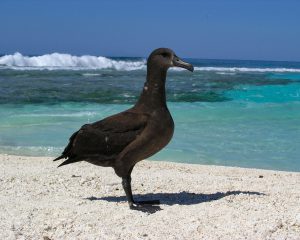 Kaʻupu
Black-footed Albatross
-
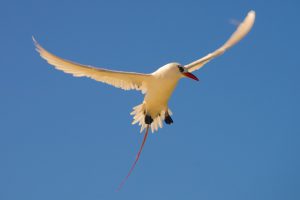 Koaʻe ʻula
Red-tailed Tropicbird
-
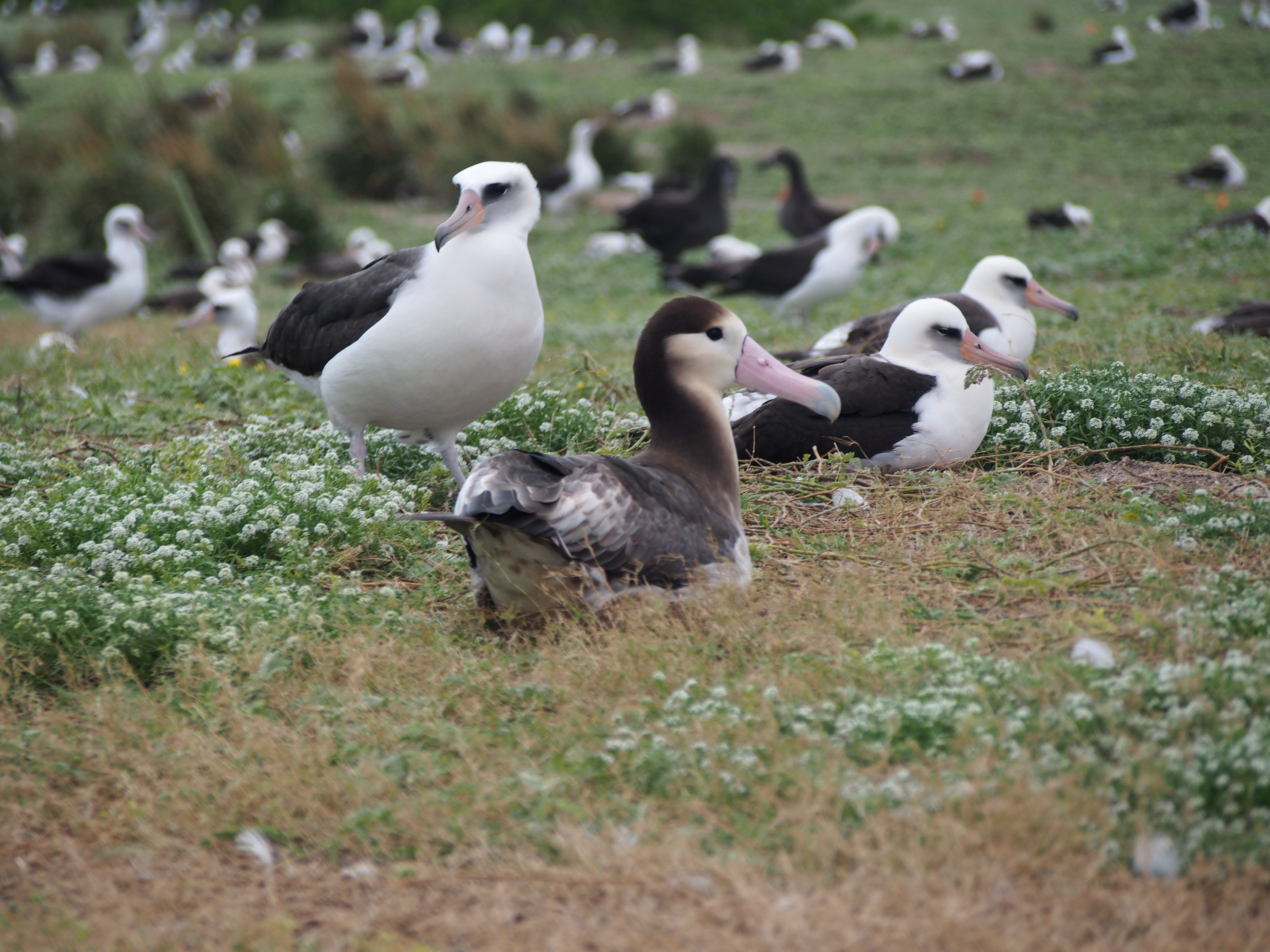 Makalena
Short-tailed Albatross
-
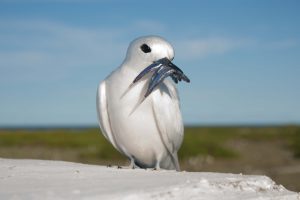 Manu-o-Kū
Blue-billed White-Tern
-
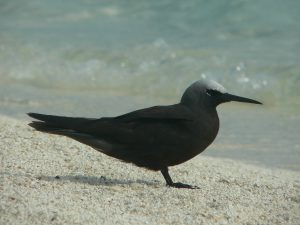 Noio
Black Noddy
-
 Noio kōhā
Brown Noddy
-
 Nunulu
Bonin Petrel
-
 ʻOu
Bulwer's Petrel
-
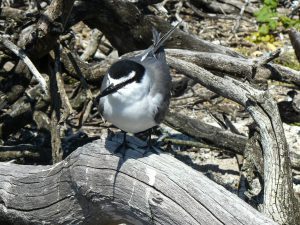 Pākalakala
Gray-backed Tern
-
 ʻUaʻu kani
Wedge-tailed Shearwater
Help protect seabirds and shorebirds on Hōlanikū
KAC/DLNR field crews monitor wildlife and restore habitat year-round. Your support keeps them on the island.