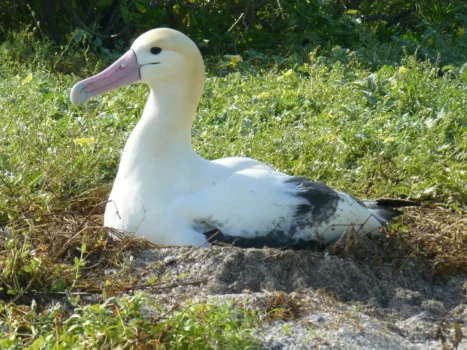
‘Ā – Masked Booby
Sula dactylatra
| State Recognized | Indigenous |
| NatureServe Heritage Rank | G5 – Secure |
| North American Waterbird Conservation Plan | Vulnerable |
| State Recognized | Indigenous |
| NatureServe Heritage Rank | G5 – Secure |
| North American Waterbird Conservation Plan | Vulnerable |
The ‘Ā, or Masked Booby, is the largest member of the booby family (Family: Sulidae) and, like its Hawaiian relatives, is found in the tropical regions of both hemispheres. There are four recognized subspecies of ‘Ā, with one (S. d. personata) being resident in Hawai‘i. These birds have long, pointed wings and short, wedge-shaped tails. Adult males and females are predominantly white, except for their brownish-black tails, black trailing edges on their wings, and black facial skin around the bill. The large bill varies in color from yellow to orange and is usually brighter in males; females are larger than males.
The flight of the ‘Ā is characterized by strong flapping interspersed with gliding, involving a rhythmic ascent during flapping and a descent while gliding. The Masked Booby forages either alone or in large flocks that include several species associated with schools of predatory fish, which drive prey to the surface. They can forage as far as 150 kilometers (90 miles) from shore, capturing prey by plunge-diving from heights up to 30 meters (100 feet) over the water, typically diving to depths of three to four meters (10 to 13 feet).
In Hawai‘i, their diet consists almost entirely of fish, primarily flying fish and jacks. The ‘Ā breeds in dense colonies, with most individuals returning to their natal colony to mate. At Kure, for instance, at least 45 percent of pairs remain together for a second breeding season. They typically nest on open ground, often near a cliff edge or on low sandy beaches, laying eggs in a shallow scrape.
Unlike many seabirds, Masked Booby usually lays two eggs per breeding season. The eggs do not hatch simultaneously, and the first chick to hatch often pushes its sibling out of the nest. In Hawai‘i, the breeding season is synchronized, with eggs laid between January and July, and the young fledge about five months after the eggs are laid. Both parents take part in incubating the eggs, brooding, and feeding the chicks. The adults continue to feed the young for up to six months after they begin learning to fly. The birds typically breed for the first time at three to four years of age, and the oldest known individual lived to be 20 years old.
The masked booby primarily breeds in the Northwestern Hawaiian Islands (NWHI), but it also breeds in the Main Hawaiian Islands (MHI), specifically on Ka‘ula, Lehua, and Moku Manu. Outside of Hawaii, masked boobies breed on islands located in the tropical waters of the Pacific and Atlantic Oceans, as well as the Red Sea.
During the non-breeding season, these birds are typically found near their breeding colonies, although some individuals may travel thousands of kilometers away from these locations.
In 2005, the estimated population of breeding pairs in Hawai‘i was around 2,500, with the majority located on the Northwestern Hawaiian Islands (NHWI). Approximately 450 pairs were breeding in the Main Hawaiian Islands (MHI). The global population is estimated to be several hundred thousand birds.
Masked boobies breed on small islands or islets, including low-lying coralline sand islands and high volcanic islands. They nest in open areas on sandy beaches or on cliff ledges.


ʻĀ are revered through profound kinship in meaningful practices of traditional Hawaiian lifestyles. Many of those understandings are being re-awakened through the community, the Office of Hawaiian Affairs, and the Kiamanu Project.
1. nvi. Fiery, burning; fire; to burn, blaze. Fig., to glitter or sparkle, as a gem; to burn, as with jealousy or anger. ʻĀ akaaka, to shine brightly, as stars. ʻĀ ke kaimana, the diamond sparkles. hoʻā To set on fire, burn, ignite; to light, as a lamp. Fig., to incite, arouse. Ua hoʻā ʻia kona inaina, his anger was aroused. Hoʻā imu, to light an oven; one who lights an oven. (PPN kakaha, PNP kaa.)
2. nvi. Aa lava, or lava rock, as distinguished from smooth unbroken pāhoehoe lava (formerly preceded by ke); to flow, as aa lava.
3. Same as ʻaʻa 1, to dare. ʻAʻole ʻoia i ʻā e noho, he did not dare to stay.
4. n. Red-footed Booby bird (Sula sula rubripes), Brown Booby (Sula leucogaster plotus), Masked or Blue-faced Booby (Sula dactylatra personata); all indigenous and also breeding elsewhere. Also ʻaʻa. Legendary birds believed to have taken the shape of this bird are ʻā ʻaia, ʻā-ʻai-ʻanuhe-a-Kāne and ʻā-ʻaia-nui-nū-keu; ʻā by some were considered ʻaumākua. See also Kep. 33.