
Pōpolo
Nelson's horsenettle
Solanum nelsonii
An endangered native shrub found only in Hawaiʻi, brought back to Hōlanikū and now growing across the island.
| Status in Hawaiʻi | Endemic |
|---|---|
| Federally listed | Endangered (2016) |
| On Hōlanikū | Reintroduced; widespread |
Species Information
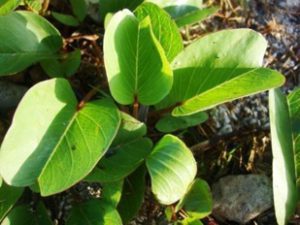
Pōpolo (Solanum nelsonii) is a sprawling shrub or low, clumping groundcover up to 3 feet tall in the nightshade family (Solanaceae). Its thick, heart-shaped, gray-green leaves are covered in fine, velvety hairs. The small, white, bell-shaped flowers are sometimes tinged with pink or purple, and the round berries ripen from red and orange to black.
It is not the same plant as the non-native American black nightshade (Solanum americanum), sometimes also called pōpolo, which crews remove as an invasive weed.
Distribution & Habitat
Pōpolo is found only in Hawaiʻi, where it grows low in coastal sites on coral rubble and sand. It was listed as an endangered species by the U.S. Fish and Wildlife Service in 2016. Nihoa has by far the largest population, with more than 16,000 plants.
On Hōlanikū
Pōpolo had disappeared from Hōlanikū and was brought back. It has since spread widely by seed and now grows in many parts of the island, in large patches in the open areas of the Poles and increasingly within naupaka. The removal of big-headed ants (Pheidole megacephala) in 2014 helped it recover.
Restoration & Management
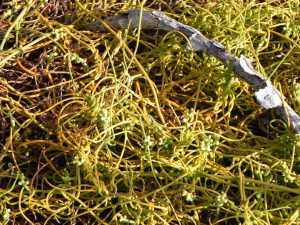
Pōpolo is vulnerable to kaunaʻoa pehu (Cassytha filiformis); when the vine grows on a plant, crews cut out the affected parts by hand. Because it is endangered, crews take care not to spray pōpolo with herbicide, especially since the pre-emergent in the mix can stop its seeds from sprouting.
More plants of Hōlanikū
-
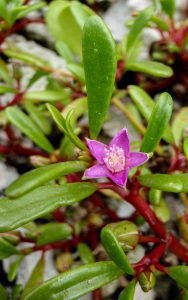 ʻĀkulikuli
Sesuvium portulacastrum
-
 ʻAlena
Boerhavia repens
- ʻĀnaunau Lepidium owaihiense
-
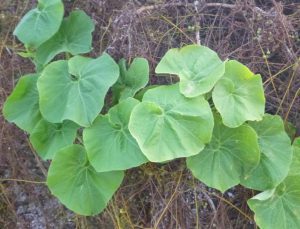 ʻĀnunu
Sicyos maximowiczii
-
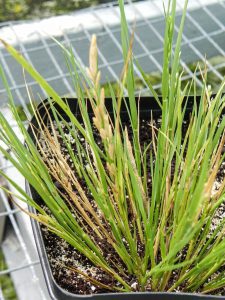 Dwarf eragrostis
Eragrostis paupera
-
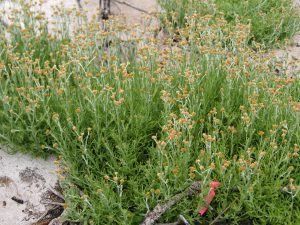 ʻEnaʻena
Pseudognaphalium sandwicensium var. sandwicensium
- ʻIliahi aloʻe Santalum ellipticum
-
 Kaunaʻoa pehu
Cassytha filiformis
-
 Kāwelu
Eragrostis variabilis
- Koali ʻawa Ipomoea indica
- Makaloa Cyperus laevigatus
- Maʻo Gossypium tomentosum
-
 Mauʻu ʻakiʻaki
Fimbristylis cymosa
- Naio Myoporum sandwicense
- Nanea Vigna marina
-
 Naupaka kahakai
Scaevola taccada
-
 Nohu
Tribulus cistoides
-
 Pacific Island thintail
Lepturus repens
-
 Pōhuehue
Ipomoea pes-caprae
Help protect native habitat on Hōlanikū
KAC/DLNR field crews monitor wildlife and restore habitat year-round. Your support keeps them on the island.
