
Kāwelu
Variable lovegrass
Eragrostis variabilis
The dominant native bunchgrass of Hōlanikū, whose deep roots hold the sand so seabird burrows don't cave in.
| Status in Hawaiʻi | Endemic |
|---|---|
| On Hōlanikū | Abundant and spreading |
Species Information
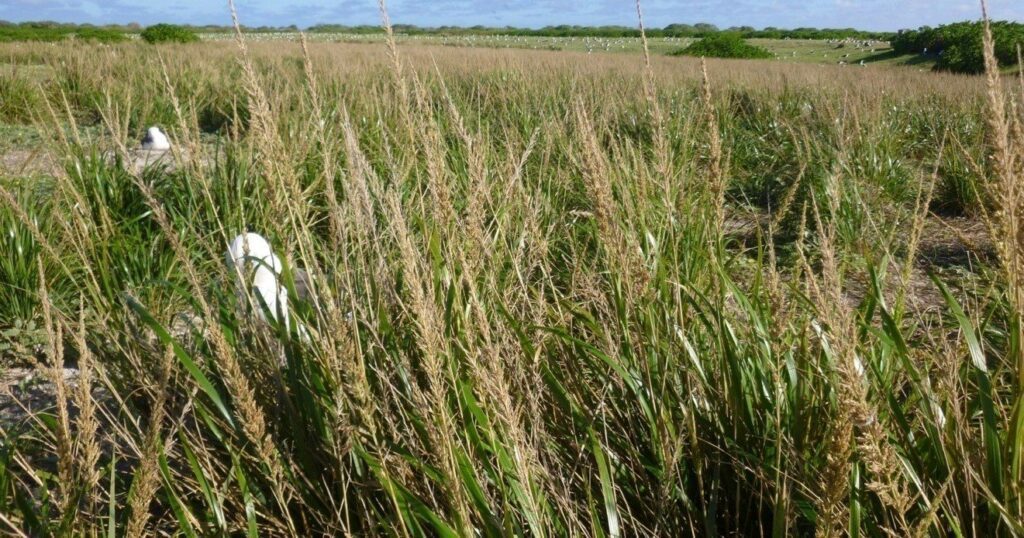
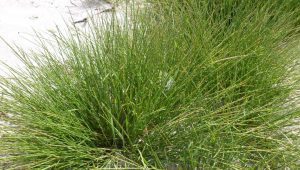
Kāwelu (Eragrostis variabilis) is one of the largest grasses on Hōlanikū (family Poaceae), forming dense bunches that can be more than 3 feet tall and wide. Its blades are long, stiff and flat with a dark, shiny surface and no central rib. The brownish-red flowers grow in open, spike-shaped clusters.
Distribution & Habitat
Kāwelu is found only in Hawaiʻi, where it grows from coastal dunes to dry slopes on all the main islands and in the Northwestern Hawaiian Islands. On Hōlanikū it grows in almost every habitat, especially sunny, open areas, and is most abundant and dense in the central plains and the northern plains.
On Hōlanikū
Kāwelu is a habitat maker. Its deep roots hold the sand so burrows don't cave in, giving nesting habitat to burrow-nesting seabirds such as nunulu (Bonin Petrels), ʻuaʻu kani (Wedge-tailed Shearwaters) and ʻakihikēʻehiʻale (Tristram's Storm-Petrels). Its bunches also shade albatross chicks and help stabilize the soil.
Kāwelu continues to spread across the island and was flowering and seeding heavily through the Winter 2025 season. It is one of the plants kaunaʻoa pehu (Cassytha filiformis) most often grows over.
Restoration & Management
Kāwelu needs to grow in a solid patch to persist, so crews avoid planting it into dense ʻalena and nohu groundcover, which can crowd it out. In the Winter 2025 season, crews raised kāwelu seedlings in pots and outplanted 30 at Brad's Pit in May 2026. Crews also measure kāwelu cover in vegetation study plots to track how restoration is going.
More plants of Hōlanikū
-
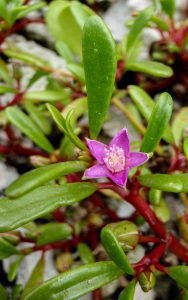 ʻĀkulikuli
Sesuvium portulacastrum
-
 ʻAlena
Boerhavia repens
- ʻĀnaunau Lepidium owaihiense
-
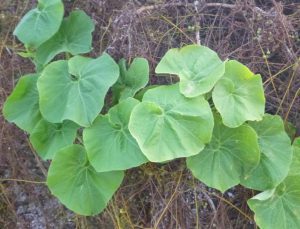 ʻĀnunu
Sicyos maximowiczii
-
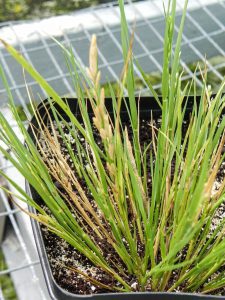 Dwarf eragrostis
Eragrostis paupera
-
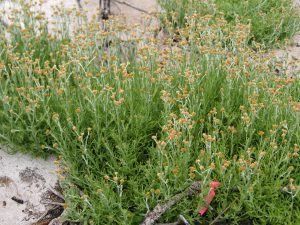 ʻEnaʻena
Pseudognaphalium sandwicensium var. sandwicensium
- ʻIliahi aloʻe Santalum ellipticum
-
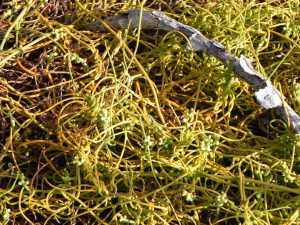 Kaunaʻoa pehu
Cassytha filiformis
- Koali ʻawa Ipomoea indica
- Makaloa Cyperus laevigatus
- Maʻo Gossypium tomentosum
-
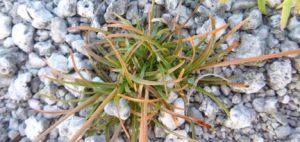 Mauʻu ʻakiʻaki
Fimbristylis cymosa
- Naio Myoporum sandwicense
- Nanea Vigna marina
-
 Naupaka kahakai
Scaevola taccada
-
 Nohu
Tribulus cistoides
-
 Pacific Island thintail
Lepturus repens
-
 Pōhuehue
Ipomoea pes-caprae
- Pōpolo Solanum nelsonii
Help protect native habitat on Hōlanikū
KAC/DLNR field crews monitor wildlife and restore habitat year-round. Your support keeps them on the island.

