Nohu
Tribulus cistoides
| State-recognized | Indigenous |
| State-recognized | Indigenous |

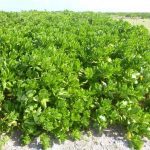
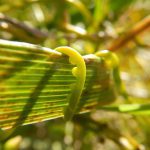
Tribulus cistoides is a native plant to Kure, called nohu, and is abundant in open areas. Its leaf pattern and yellow flowers are unmistakable. The cotyledons (sprouting leaves) are large and blunt-ended, giving them an almost rectangular shape with an obvious central nerve. The true leaves grow out one at a time and are immediately recognizable by their many-branched, paripinnate pattern.
Nohu is a perennial plant that experiences some dieback from October through March—when days are much shorter and temperatures much colder than in summer. It grows as a trailing vine with weak nodes that easily separate from the rest of the plant when you try to pull a vine. This makes the vine a good source of nesting material rather than koaliʻawa because it snaps off easily at its many nodes. The ʻiwa and Red-footed Boobies have been observed exhibiting this behavior around camp.
The most obvious attribute that gets your attention, however, is the sharp thorny seeds that are produced. Walking around Kure with thick sole shoes are required. Unfortunately, the thorns also injure the birds on Kure. Albatross are often seen on Midway on the old runways—a place with a lot of nohu—and the thorns push easily into adult and nestling albatross feet. nohu has been removed from the old runway on Kure for that reason.
Similar to ʻalena (Boerhavia repens), the nohu plant is not grown in the nursery because it is widely distributed throughout the island. The seed bank for ʻalena and nohu persisted during the invasion of Verbesina enciloides. And when Verbesina was being removed from restoration areas, ʻalena and nohu would return imperviously as ground coverage.
Notably, ʻalena and nohu can, by nature, be dominating even over other natives. This made re-planting Kāwelu (Eragrostis variabilis) into the Kure landscape a strategic effort. For example, knowing that Kāwelu needs to be a solid patch in order for it to persist and knowing that ʻalena and nohu can be a dominating ground cover, planting Kāwelu, then, in a field of ʻalena and nohu would not be a successful start-up for the Kāwelu. The success of the eradication of Verbesina on Kure has to acknowledge this subtle yet significant intraspecies competition in order to be successful in the overall restoration efforts as well.


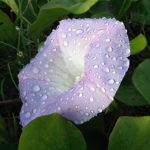
The tiny naupaka flower, the nohu fragrance permeates the air. (Kaala Faye Camara)
The tiny flower of the nohu fills the air masking the smell of decay and death due to the high numbers of juvenile mōlī and kaʻupu that didnʻt survive departure.