
23 November (32 days on island)
This week we treated approx. 38.5 acres and went through some pretty tough terrain because of both burrows and naupaka density. My body feels pretty stiff. I found some verbesina sprouts, which I was proud of, because it confirms that I’m learning and also scanning for weeds effectively. Sometimes when you go for a little while without finding anything, especially at the start of a habitat restoration placement, you start questioning whether there’s really nothing there, or whether it’s simply you not finding/seeing it (aka being bad at your job). But these past days I’ve found sprouts of both flaveria trinerva and verbesina, so that was a confidence booster.
We’ve now been here one month. It’s simultaneously hard and easy to believe this. Hard, because in one sense, it feels like yesterday that I stepped off the landing craft onto the white sand beach of Kure Atoll. And really, a month isn’t a long time in the scheme of things. But easy to believe in the sense that I feel I’ve changed and aged since being here in ways which would, under normal circumstances/in normal life, be the product of a longer period of time. Being here has already allowed for a lot of personal growth and introspection, and learning through natural history observation. I’ve seen so much and absorbed so much, it feels like the days are stretched out, with one day containing what a whole week might normally hold. At the end of each day, that day’s morning feels like it happened several days ago. I don’t know if that makes sense to someone on the outside – it’s hard to describe.
The days are cooler now than when we arrived. More clouds gather, and often there is rain. In the morning I wake up naturally between 5 and 6, and my morning routine consists of having my morning coffee, then walking down to the pier in the dark to observe the BFAL, often lit by moonlight, and to survey the lagoon. This morning there were tens of thousands of stars out, with numerous shooters, and I was struck yet again by the strong feeling of being a tiny being in a large star dome, with stars stretching in every direction down to the horizon, and the bright half-moon above.
Activity in the albatross colony is reaching a fever pitch, with many eggs now laud, nests being furiously scraped together, dancing occurring everywhere you look in the evenings, lone birds still whistling and clacking to attract a mate – it’s the biggest event of the year, and everyone is excited. The nest building is a funny one. They will often sit and start by moving some sticks and stems around, then when the egg-time is nearer, they will start picking up all the vegetation and dirt that their reach will allow them. Instead of pushing the dirt or sand with their bills and/or feet, the majority of it is moved seemingly grain by grain, piece by piece, with the tip of the bill. Hugely inefficient, but there you go. That’s how it’s done. So a good nest bowl will have a little perimeter of dark, clearer earth around it, its width equal to the length of the bird’s reach whilst it is sat on the nest.
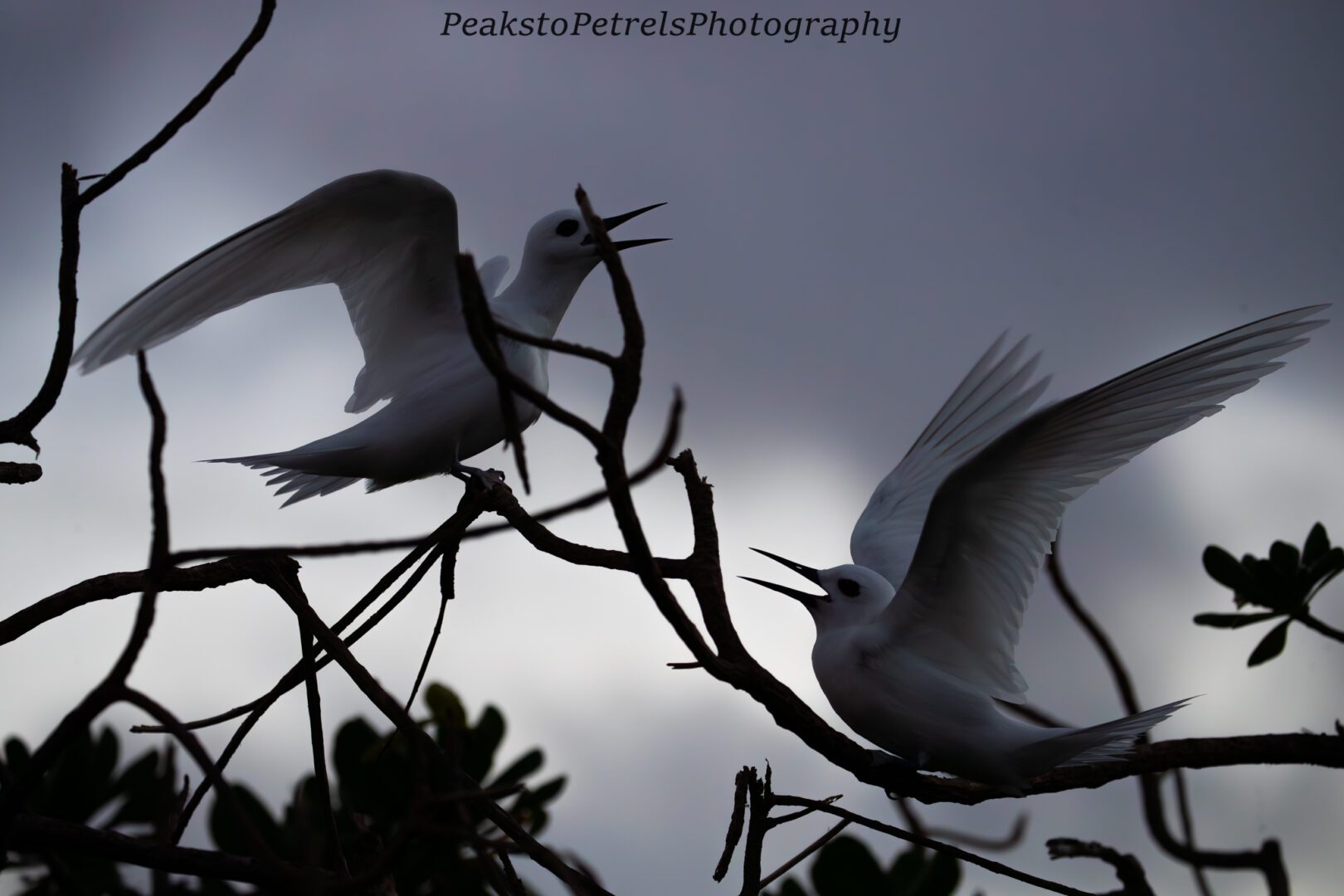
When treating one of the dune GRAs this week I spotted/heard an adult tropicbird screaming bloody murder at an albatross. I approached cautiously, and noticed that tropicbirds apparently are not the brilliant white they appear in flight – they in fact have a beautiful, and strange, pink tinge to their feathers. White terns also hide a special secret for the observant: the deep, surreal blue colour at the base of their black bills.
On Thursday evening there was a truly fantastic sunset. Even for here, it was impressive. I emerged from the beach path and had to stop in my tracks in awe. There was significant cloud cover, but this did not stop the sun. In fact, huge sun beams streamed down to the sea from gaps in the clouds, and the foam flying off the distant reef waves was lit by these, so that we appeared to be fringed by a golden halo. It was almost as if the clouds were trying to prevent the sun from shining through, but he was so powerful that he literally pierced them with his brightness. To the south the sky was a bit clearer, with the clouds more distinct from one another, which had the effect of creating a most pleasing colour palette. The clouds were a pale lavender tinged with delicate yellows and pinks, with the sky behind them a clear, deeo blue. I climbed up onto the pier shed roof and watched albatross soaring up and down the beach in the gusts. Hundreds of them, clouds of them, could be seen in the sky above south point. Once in awhile one would fly close by, and I’d get the unique perspective of looking down onto a flying albatross.
A special moment for me this week occurred on Friday, our official one-month anniversary. We were out doing a shorebird survey, split into 2 groups around the island. I was with Ryan and Jacob down close to north point, and Nadia and Tlell were down at west turnaround. Then, over the radio came the call from Nadia: ‘we have a short-tail!’. It felt as though my heart had skipped several beats and then suddenly decided to make up for it by jumping up into my throat. A decidedly unpleasant sensation! Short-tailed albatross are one of my ‘life birds’ – not just a lifer, but a life bird, as in, seeing it would be a defining moment in my life. Seeing a life bird is important not just because one has not seen one before, but primarily because of the intrinsic qualities of the bird. I hi-tailed it out of there and all the way down to south point, where I found Nadia and Tlell. I was terrified the bird would leave before I arrived. I’ll always remember the moment I saw it – the incredible pink and blue bill, the dark, expressive round eyes with no mascara or brow, the chocolate brown plumage on the back of the head and neck, fading through to a soft gold and then cream on the throat, face and belly. Hidden behind a naupaka bush, we watched it wander around, interacting, interestingly, only with the BFAL. They of course were having none of it, snapping at the short-tail, screaming, clacking, and biting, despite it being nearly twice their size. It seemed rather confused in response to their hostility. It led out a loud sky-call, and a couple of moos. After another 15 minutes of visiting various annoyed BFAL, it ruffled its feathers, and took off towards the north. I looked for it again later in the evening, but did not see it again. I still can’t believe our luck at seeing one, as they do not nest on the atoll, and they are incredibly rare, with only a few thousand left in the world. These majestic birds were harvested by their millions at the turn of the century, all for their golden feathers, which sold at a high price and were in demand by the fashion industry. A great injustice was perpetrated upon them, as it currently being continuously perpetrated on most other seabird species, in the form of plastic pollution, overfishing, habitat destruction, and being caught as bycatch. This short-tail was unbanded, and probably hailed from Japan.
Seeing things like a short-tail take off, or arch its beautiful neck; watching a black-footed albatross drop its egg, with both parents seeming to speak to it softly; witnessing a lightning fork down into the sea a mere mile away; and observing age-old courtship rituals by the light of the moon – these moments continue to add to the incredible things I’ve seen in my life and in my adventures on this earth. Things like hiking the Pacific Crest Trail in its entirety last year; watching volcanoes erupt in the night whilst mist-netting petrels; hiking across mountain rages without a trail to see three-storey tall glaciers calving off into roaring rivers; ravens barrel-rolling in the air simply for the joy of flying, whilst stood on the top of an icy, craggy peak. I’ve witnessed many unbelievable and spectacular things in my mere 30 years, but I feel that my time here on Kure will add many more moments to this collection, whose value is greater than anything else I possess. What a gift it is that we humans have been granted – the ability to assign meaning to the world, to the things we see and witness. But when viewed in the context of our own mortality, these moments and memories hold a terrible beauty. What happens to them all when we die?
The more time I spend here, and the more things I witness, the more I am reminded of the famous Bladerunner closing soliloquy: ‘I’ve seen things you people wouldn’t believe. Attack ships on fire off the shoulder of Orion. I watched C-beams glitter in the dark near the Tannhauser Gate. All those moments will be lost in time, like tears in rain’.
Aloha,
Isabelle Beaudoin (PeakstoPetrelsPhotography)

