
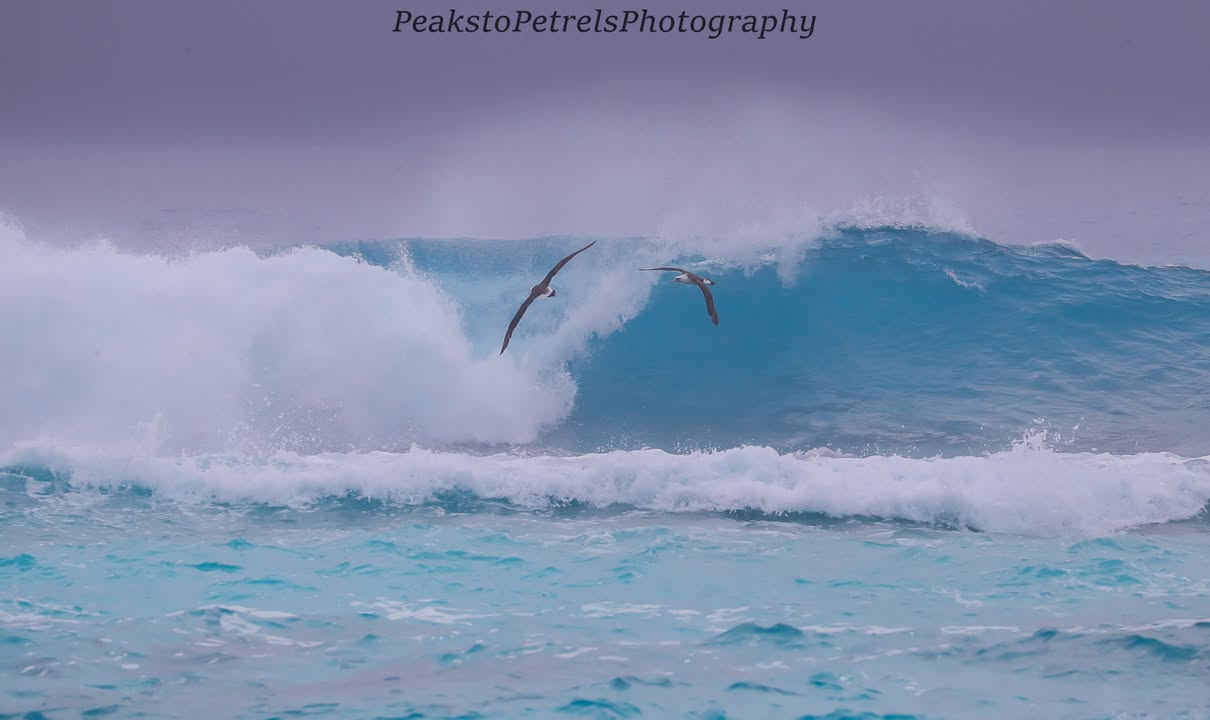
The Hōlanikū Eddie Aikau Big Wave Competition is on!
Soul surfing albatross are not drawing the crowds that Oahu’s North Shore did today, but they sure look like they are having fun! I love this blog by Isabelle, she really lays out the ups and downs of a field biologist. Her description of finding an albatross hanging in a heliotrope tree really drives home why we need to continue our restoration efforts to control these trees. They are not only hazards to seabird navigation, they also compete with the native vegetation that stabilized the ground. Heliotrope trees were introduced to Kure in the 60s, and if left unchecked they will create solid heliotrope tree forests with nothing growing underneath to stabilize the sand. – Cynthia Vanderlip (KAC Executive Director)
Isabelle’s Blog:
22 December (60 days on island)
This week was… oh man, how do I describe this week. In one word? Grueling. But there were also many special, or heart-rending, moments that deserve retelling.
On Monday we started the great albatross nest count. That’s when we count all the albatross nests on the island. Everywhere. If Kure were a giant open field, this would be easier. However, Green Island is a patchwork of open areas and thick naupaka. So, most of my week was spent purely bushwhacking, often through 12ft high – or higher – naupaka. For scale, I am only 5’2”. Words cannot describe the struggle, and the intense frustration, which was felt many times by all members of the crew this week. This stemmed mostly from the burrows. Since Kure is riddled with Bonin petrel burrows, every step is precarious, and at most times you are threatened by a drop of anywhere from 1-3ft down into the ground. This happens even when you are walking very slowly, looking carefully for any sign of an entrance nearby so that the direction of the tunnel can be gauged, and the burrow therefore circumnavigated. Falling through burrows, along with the danger of burying a bird, plays on your mind constantly. It is also very tiring to get down to dig the burrows out, sometimes every few steps. Fun is not how I would describe the albatross nest count on Kure, but it must be done to get a sense for the yearly population trends of Laysan and black-footed albatross, and I am here to do what must be done for this island, and for these birds – whatever that may be. On Friday however, I was totally knackered. This exhaustion was made worse by the issue in the bunkhouse of the dermestid beetles. You see, these fall on my head from the ceiling, and I’ve found them wriggling in my shirt collar at night, waking me up, or I hear them falling on my pillow next to me. This is very unnerving, and has for some reason been getting worse this past week than at any previous point in the season. I have really struggled to get to sleep, and to stay asleep. But – on Saturday, I decided to put an end to it and to fashion myself a ‘beetle-net’ from an old mosquito net and various pieces of netting we had, which I attached together to create an enclosed area around my bed, which is totally enclosed once I get into it. And last night I slept very soundly indeed. So, this seems to be the solution. The beetles will keep abiding in my bedroom, and that is annoying, but at least I can sweep them up. In my bed however – that is another matter, and I draw the line there. But thanks to my beetle-net, hopefully the nights of fitful sleep are behind me, and I can start to really recover mentally and physically. There are certainly some trials and tribulations of working here, and this job is not for the faint of heart. But the rewards you get for it – living here, in the moment, in the present, surrounded by such beauty, drama, such vibrancy of life – more than make up for all discomfort.
There were several moments I’d like to recount from this week. First, one that affected me deeply, and one I still feel is difficult to talk about. On Tuesday morning, first thing, about 10 minutes after I’d started my count, I rounded the corner on the back side of the island and saw a terrible sight. An adult Laysan was hanging from a dead heliotrope branch by its left wing. He was still alive, body and right wing dangling down helplessly in the air. I sprinted over the short distance separating us, and assessed the situation. The injury was catastrophic – the bird had obviously flown straight into the branch, probably at night, and it had skewered the wing tissue. The wing was not merely caught, it was ripped open. I radioed for help, as, whilst I knew this injury would be deadly, the bird could not be left dangling like that. As I waited for Nadia, I held up the huge bird so that less weight was placed on the wound, hopefully giving a slight bit of comfort. He looked down at me from those huge, sparkling eyes. I told him it would be ok, knowing both that he did not understand me, and that it would not be ok. But I said it anyways, not knowing who the words were really intended for: me or the bird. Nadia came over and helped me from where she was counting birds in a nearby GRA, and together we eased the bird down, and made him as comfortable as we could under a naupaka bush. Although I knew that this was a natural phenomenon, and an accident not caused by human doing, and therefore a part of the natural threats and lives and deaths of these birds, I nonetheless burst into tears as I knelt there, looking at this magnificent bird brought low. Such strength in those wings, but also such fragility. Nadia and I sat there and shared this moment of sorrow together. I was glad of her presence. After she left, I sawed down the offending branches that had so hurt my friend the albatross, with their ends sharp like spears. But there were many more dead heliotropes with sharp branches than I alone could cut down.
I went back a few days later to this area to conduct other seabird monitoring business, and found the bird’s body not far away. It already showed strong signs of decay, meaning he had probably died the same day, or the day after, I’d found him in the tree. He had not suffered long. I could not dig a grave there because of the density of burrows, so instead piled some sweet alyssum over the body and gave it a headstone of coral. At least now, my friend could turn into bones with some privacy. Fair winds to you, wherever your spirit now flies. This difficult event still haunts my thoughts and dreams, and though you might find it hard to read about, I believe I needed to share it.
Whilst this week held moments of great sorrow for me, it also, like all weeks here, held moments of elation. Seeing a mature adult short-tailed albatross for the first time – wow. What a bird. When I watched it this morning in the light of the rising sun, its golden head-feathers shimmered like gold-leaf, seemingly lit from within as well as from without. The black pit of its eye drew me in. I could fall straight into it, like Alice in Wonderland, but Isabelle into Birdland. I watched it rain-nibble, watched it moo, watched it preen, watched it shake, watched it interact with the Laysan albatross, watched it walk around, watched it stretch out its massive wings. I really do sometimes feel like one of the luckiest people on this earth to be here, on this atoll. Another strongly memorable moment for me came this morning. Having not seen the sun properly for well over 24 hours, and yesterday being such a grey day, and a very dark night, when the sun rose this morning, the colors in the sky seemed even brighter than normal, the sun itself blinding. The wind was up, and all the albatross were flying around like mad. Never before had I seen such a concentration of them in the skies. They gave a similar impression to the Bonin clouds I see most nights. They flew straight in front of the rising sun, almost seeming, like us, to celebrate the return of the light, the wind, the warmth (for me, that stemmed partially from a desperate need for my laundry to be dried). A further treat came in the form yesterday of watching the albatross fly over the house-sized breakers over the reef. They masterfully traced the giant waves as they grew and grew, until just before they broke, then moving just out of reach of the white foam as it came crashing down upon itself thunderously. They were not hunting for food here, and watching them then, it truly did feel as though they did it simply for the exhilaration, the joy, of it. I was thankful, because of the thrill and joy it gave me watching them.
We have now been on island two months exactly, and today, though it is cold and the first day of winter, the days begin once more to grow longer – the sun will rise earlier in the day instead of later, as we continue to grow more and more in tune with the world’s celestial rhythms.
Cheers to Hōlanikū, to albatross, to friendships, to compassion, to idealism, to love – to spirits here, and to those departed, gone but not forgotten. And a Merry Christmas to you all.
Aloha,
Isabelle

