
‘Ūlili – Wandering Tattler
Tringa incana, Heteroscelus incanus
| State Recognized | Indigenous |
| US Shorebird Conservation Plan | Moderate Concern |
| State Recognized | Indigenous |
| US Shorebird Conservation Plan | Moderate Concern |
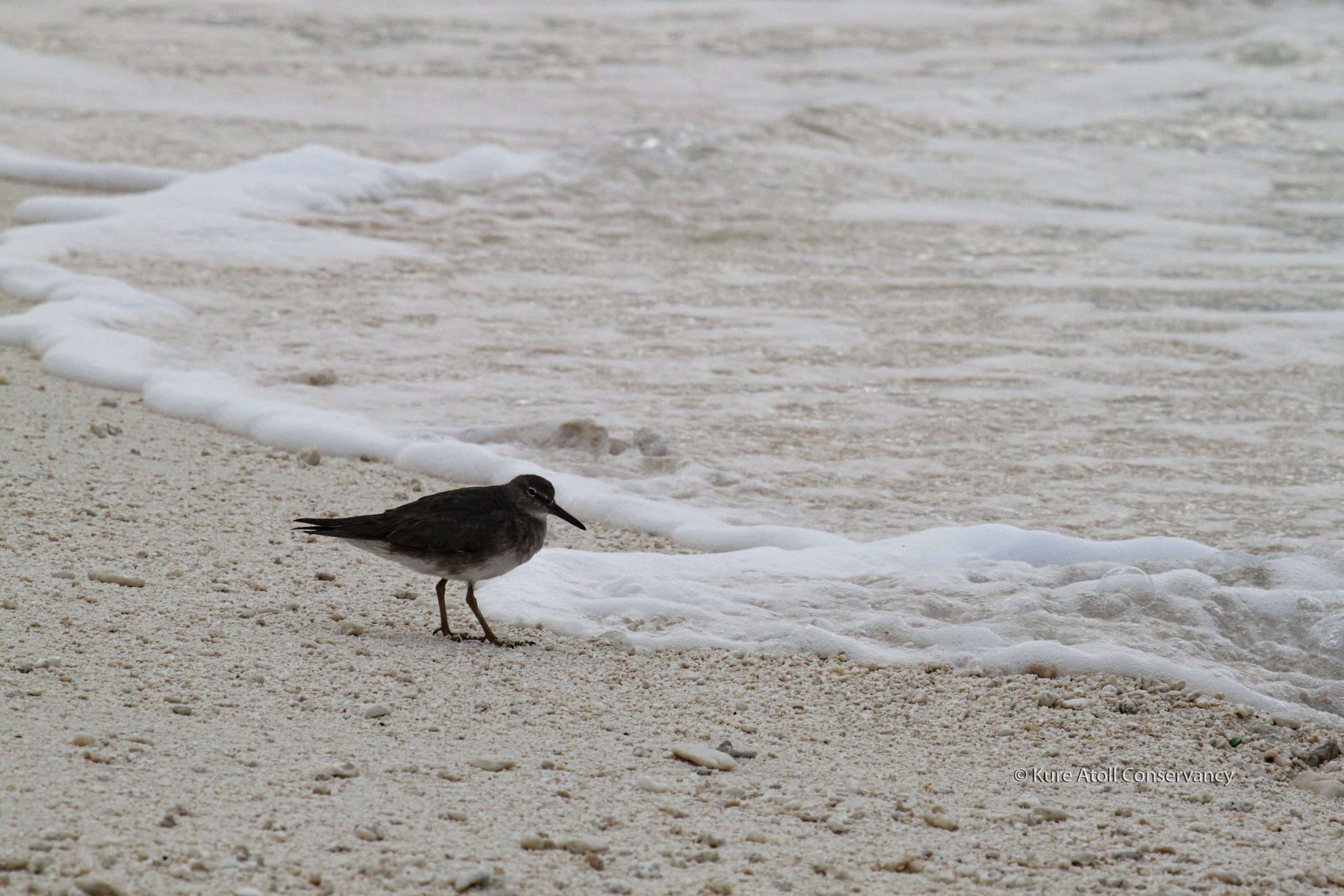
‘Ūlili, or Wandering Tattler, remains one of North America’s least known birds. ‘Ūlili winter in the Hawaiian Islands, arriving in stages (adults from July to August, juveniles from September to November) and showing strong winter range fidelity.
Diet varies with season, and in winter mainly consists of invertebrates such as marine worms, aquatic insects, mollusks, crustaceans, and small fish. On nonbreeding grounds, forages in intertidal habitats (such as coral reefs), less frequently in soft mud or sand, picking food from moist substrates or surface of shallow water. ‘Ūlili also forage along mountain streams, in wetlands, fish ponds, and human-modified areas.
‘Ūlili breed mostly in mountainous areas of Alaska, and also in eastern Siberia, but densities are sparse so that precise identification of breeding areas is lacking. Winter range includes most of Oceania from Hawai‘i through more southerly archipelagos. Most abundant in the southern and central Pacific. Less common or infrequent in more distant areas of the Pacific. In Hawai‘i, ‘ūlili are more prevalent on shorelines of the NWHI than in the MHI.
Wintering habitats throughout the Pacific and mainland Asia are more varied than breeding habitat. ‘Ūlili are common in coastal areas on coral reefs and the basalt platforms of most atolls and islands. They will also make use of soft substrates, especially river mouth areas and littoral margins of lagoons. In the NWHI, they can be found on pickleweed (Sesuvium portulacastrum) flats, and elsewhere in Hawai‘i they will forage in grassy areas around airports and golf courses.
For more information and references, visit the DLNR State Wildlife Action Plan factsheets.
Primary threats include the following:


ʻū.lili
1. n.v. Wandering tattler (Heteroscelus incanum), a slender regular winter migrant to Hawaiʻi, slaty above and white with dusky bars and streaks beneath. It breeds in Alaska and the Yukon. The cry of the bird; to cry thus. hoʻū.lili To act like the tattler bird. (PPN ku(u)lili.)
2. n. Police whistle; ancient type of bamboo whistle; sound of these whistles. The whistles are said to be named for the cry of the tattler.
3. n. A bamboo tube used for blowing on a fire; to use this tube.
4. n. A musical instrument consisting of three gourds pierced by a stick; a whirring sound is made by pulling a string, thus twirling the gourds.
5. n. Hula step similar to ʻuwehe, except that only one heel at a time is raised; this step has a distinctive beat.
6. Same as hū, small gourd used as a spinning top; to spin this top.
7. vs. Steep, as a mountain road.
8. vs. Firm. Kaula ʻūlili, strengthening cords holding the canoe cover (ʻahu uhi waʻa) in place. See wai ʻūlili.
9. n. A religious ceremony in ʻanāʻanā, sorcery.
10. Var. of hulili. Kuʻu ʻia maila kekahi ānuenue i ʻūlili ʻia (Laie 581), let down a rainbow that sparkled. (PCP kulili, cf. Marquesan kuʻiʻi.)
11. n. Poles separating bannisters, as on stairs; rails of hōlua sleds.
A webinar related to the research of the Papahānaumokuākea Native Hawaiian Cultural Working Group tasked with giving Hawaiian names to numerous other bird, plant, limu, and coral species unique to PMNM
